Family Planning National Training Cneters Frequently Used Codes
Contraception
In choosing a method of contraception, dual protection from the simultaneous run a risk for HIV and other STDs besides should be considered. Although hormonal contraceptives and IUDs are highly effective at preventing pregnancy, they do not protect against STDs, including HIV. Consistent and right utilize of the male latex condom reduces the run a risk for HIV infection and other STDs, including chlamydial infection, gonococcal infection, and trichomoniasis.
Reversible Methods of Birth Control
Intrauterine Contraception

Levonorgestrel intrauterine system (LNG IUD)—The LNG IUD is a small-scale T-shaped device similar the Copper T IUD. Information technology is placed inside the uterus by a doctor. Information technology releases a pocket-size corporeality of progestin each twenty-four hours to keep you from getting pregnant. The LNG IUD stays in your uterus for up to 3 to six years, depending on the device. Typical utilize failure rate: 0.1-0.iv%.1
Copper T intrauterine device (IUD)—This IUD is a small device that is shaped in the grade of a "T." Your doctor places it inside the uterus to prevent pregnancy. It can stay in your uterus for up to 10 years. Typical use failure charge per unit: 0.8%.one
Hormonal Methods

Implant—The implant is a single, sparse rod that is inserted under the skin of a women'southward upper arm. The rod contains a progestin that is released into the body over three years. Typical use failure charge per unit: 0.ane%.ane
Injection or "shot"—Women go shots of the hormone progestin in the buttocks or arm every 3 months from their physician. Typical use failure rate: four%.1
Combined oral contraceptives—Besides called "the pill," combined oral contraceptives contain the hormones estrogen and progestin. It is prescribed by a medico. A pill is taken at the same time each day. If you are older than 35 years and smoke, have a history of blood clots or breast cancer, your doctor may advise you non to take the pill. Typical use failure rate: seven%.1
Progestin merely pill—Unlike the combined pill, the progestin-merely pill (sometimes called the mini-pill) simply has i hormone, progestin, instead of both estrogen and progestin. Information technology is prescribed by a doctor. It is taken at the same fourth dimension each twenty-four hours. It may be a skilful selection for women who tin can't take estrogen. Typical apply failure rate: seven%.i

Patch—This skin patch is worn on the lower abdomen, buttocks, or upper torso (just not on the breasts). This method is prescribed past a medico. It releases hormones progestin and estrogen into the bloodstream. Yous put on a new patch once a week for three weeks. During the fourth calendar week, you do not habiliment a patch, so yous tin can accept a menstrual period. Typical use failure rate: 7%.i

Hormonal vaginal contraceptive band—The ring releases the hormones progestin and estrogen. You place the ring within your vagina. You clothing the band for 3 weeks, take information technology out for the week you accept your menstruation, so put in a new ring. Typical apply failure charge per unit: vii%.ane
Bulwark Methods

Diaphragm or cervical cap—Each of these barrier methods are placed inside the vagina to encompass the cervix to block sperm. The diaphragm is shaped like a shallow cup. The cervical cap is a thimble-shaped cup. Before sexual intercourse, you insert them with spermicide to block or kill sperm. Visit your md for a proper fitting because diaphragms and cervical caps come in different sizes. Typical use failure rate for the diaphragm: 17%. 1
Sponge—The contraceptive sponge contains spermicide and is placed in the vagina where it fits over the cervix. The sponge works for up to 24 hours, and must exist left in the vagina for at least 6 hours after the last human action of intercourse, at which time it is removed and discarded. Typical use failure rate: 14% for women who have never had a babe and 27% for women who have had a baby. 1
Male person condom—Worn by the human, a male rubber keeps sperm from getting into a woman'southward body. Latex condoms, the most common blazon, assist prevent pregnancy, and HIV and other STDs, as do the newer constructed condoms. "Natural" or "lambskin" condoms also assist prevent pregnancy, just may non provide protection confronting STDs, including HIV. Typical use failure rate: 13%. 1 Condoms can only be used once. You can purchase condoms, KY jelly, or h2o-based lubricants at a drug store. Practise non employ oil-based lubricants such as massage oils, infant oil, lotions, or petroleum jelly with latex condoms. They will weaken the prophylactic, causing it to tear or interruption.
Female safety—Worn by the woman, the female person condom helps keeps sperm from getting into her trunk. It is packaged with a lubricant and is available at drug stores. It can exist inserted up to eight hours before sexual intercourse. Typical utilise failure rate: 21%, ane and besides may assistance prevent STDs.
Spermicides—These products work by killing sperm and come in several forms—foam, gel, foam, flick, suppository, or tablet. They are placed in the vagina no more than one 60 minutes earlier intercourse. You go out them in place at to the lowest degree six to eight hours after intercourse. You can use a spermicide in addition to a male person prophylactic, diaphragm, or cervical cap. They tin can exist purchased at drug stores. Typical use failure rate: 21%. 1
Fertility Sensation-Based Methods
Fertility awareness-based methods—Agreement your monthly fertility patternexternal icon external icon can assistance you plan to become meaning or avoid getting meaning. Your fertility pattern is the number of days in the month when you are fertile (able to get pregnant), days when you are infertile, and days when fertility is unlikely, but possible. If yous take a regular menstrual bicycle, you have almost nine or more than fertile days each month. If you practice not desire to get pregnant, yous practise not have sex activity on the days yous are fertile, or you lot use a barrier method of birth control on those days. Failure rates vary beyond these methods. one-ii Range of typical use failure rates: ii-23%. 1
Lactational Amenorrhea Method
For women who have recently had a baby and are breastfeeding, the Lactational Amenorrhea Method (LAM) tin exist used as birth control when three conditions are met: 1) amenorrhea (non having whatever menstrual periods later on delivering a infant), two) fully or nearly fully breastfeeding, and 3) less than 6 months afterwards delivering a baby. LAM is a temporary method of birth control, and another birth control method must be used when any of the iii conditions are not met.
Emergency Contraception
Emergency contraception is Not a regular method of birth control. Emergency contraception can be used after no birth command was used during sex, or if the birth command method failed, such every bit if a condom broke.
Copper IUD—Women can take the copper T IUD inserted within v days of unprotected sex.
Emergency contraceptive pills—Women can take emergency contraceptive pills upwardly to 5 days later on unprotected sex, simply the sooner the pills are taken, the better they will piece of work. There are three different types of emergency contraceptive pills available in the The states. Some emergency contraceptive pills are available over the counter.
Permanent Methods of Nascency Command
Female Sterilization—Tubal ligation or "tying tubes"— A adult female can have her fallopian tubes tied (or closed) so that sperm and eggs cannot meet for fertilization. The process can exist done in a infirmary or in an outpatient surgical center. You can go home the same day of the surgery and resume your normal activities within a few days. This method is effective immediately. Typical use failure rate: 0.5%. 1
Male Sterilization–Vasectomy—This operation is washed to go on a man'south sperm from going to his penis, and so his ejaculate never has whatever sperm in information technology that tin fertilize an egg. The procedure is typically washed at an outpatient surgical heart. The human being can become home the aforementioned solar day. Recovery fourth dimension is less than one week. After the operation, a man visits his doctor for tests to count his sperm and to brand sure the sperm count has dropped to zero; this takes near 12 weeks. Some other form of birth control should exist used until the man'southward sperm count has dropped to zero. Typical use failure charge per unit: 0.fifteen%. 1
References
- Trussell J, Aiken ARA, Micks East, Guthrie KA. Efficacy, safety, and personal considerations. In: Hatcher RA, Nelson AL, Trussell J, Cwiak C, Cason P, Policar MS, Edelman A, Aiken ARA, Marrazzo J, Kowal D, eds. Contraceptive engineering science. 21st ed. New York, NY: Ayer Company Publishers, Inc., 2018.
- Peragallo Urrutia R, Polis CB, Jensen ET, Greene ME, Kennedy E, Stanford JB. Effectiveness of fertility awareness-based methods for pregnancy prevention: A systematic reviewexternal icon. Obstet Gynecol 2018;132:591-604.
Contraceptive Effectivenessexternal icon
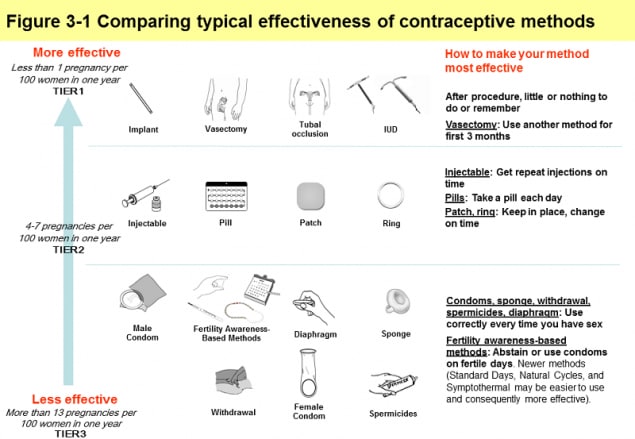
Source: Trussell J, Aiken ARA, Micks E, Guthrie KA. Efficacy, safety, and personal considerations. In: Hatcher RA, Nelson AL, Trussell J, Cwiak C, Cason P, Policar MS, Edelman A, Aiken ARA, Marrazzo J, Kowal D, eds. Contraceptive applied science. 21st ed. New York, NY: Ayer Visitor Publishers, Inc., 2018.
Resources for Providers
CDC Contraceptive Guidance for Health Intendance Providers
U.S. Medical Eligibility Criteria for Contraceptive Use (US MEC), U.Southward. Selected Practice Recommendations for Contraceptive Use (US SPR) and Providing Quality Family Services (QFP) can assist health care providers when they counsel women, men, and couples about contraceptive method choice and family planning services.
Contraceptive Use Amongst Women at Adventure for Unintended Pregnancy in the Context of Public Health Emergencies — U.s., 2016
Increasing access to contraception: resources from the ASTHO Learning Communityexternal icon
American Higher of Obstetricians and Gynecologists (ACOG) Long-A cting Reversible Contraception Planexternal icon
Family Planning National Training Center (FPNTC)external icon
National Clinical Grooming Heart for Family unit Planning (NCTCFP)external icon
Tips for Communicating with Female person Patients with Intellectual Disabilities
Resources for Consumers
- Nascency Control Methods fact sheetexternal icon (women'shealth.gov)
Métodos anticonceptivos hoja de datosexternal icon - Emergency Contraception (emergency nascence control) fact canvasexternal icon (women'shealth.gov)
Anticoncepción de emergencia hoja de datosexternal icon - Office of Population Affairsexternal icon
- Planned Parenthoodexternal icon
- His Condom + Her Nascency Control
![Download Infographic: It is your future-You can Protect It [PDF - 730 KB]](https://www.cdc.gov/teenpregnancy/images/PDF-It-is-your-future-You-can-Protect-It-200x160.jpg)
Download Infographic pdf icon [PDF – 730 KB]
- Know Your Safety DOs & DONT'South
![ownload Infographic: Know Your Condom DOs & DONT'S [PDF - 1 MB]](https://www.cdc.gov/teenpregnancy/images/index-condoms-do-dont.jpg)
Download (in English language) pdf icon [PDF – 1.84 MB] Download (en español) pdf icon [PDF – 1.39 MB]
Source: https://www.cdc.gov/reproductivehealth/contraception/index.htm
0 Response to "Family Planning National Training Cneters Frequently Used Codes"
Post a Comment